Monday, 22 May 2023

Uncovering universal physics in the dynamics of a quantum system


New experiments using one-dimensional gases of ultra-cold atoms reveal a universality in how quantum systems composed of many particles change over time following a large influx of energy that throws the system out of equilibrium. A team of physicists at Penn State showed that these gases immediately respond, "evolving" with features that are common to all "many-body" quantum systems thrown out of equilibrium in this way. A paper describing the experiments appears May 17, 2023 in the journal Nature.

"Many major advances in physics over the last century have concerned the behavior of quantum systems with many particles," said David Weiss, Distinguished Professor of Physics at Penn State and one of the leaders of the research team. "Despite the staggering array of diverse 'many-body' phenomena, like superconductivity, superfluidity, and magnetism, it was found that their behavior near equilibrium is often similar enough that they can be sorted into a small set of universal classes. In contrast, the behavior of systems that are far from equilibrium has yielded to few such unifying descriptions."
These quantum many-body systems are ensembles of particles, like atoms, that are free to move around relative to each other, Weiss explained. When they are some combination of dense and cold enough, which can vary depending on the context, quantum mechanics—the fundamental theory that describes the properties of nature at the atomic or subatomic scale—is required to describe their dynamics.

Dramatically out-of-equilibrium systems are routinely created in particle accelerators when pairs of heavy ions are collided at speeds near the speed-of-light. The collisions produce a plasma—composed of the subatomic particles "quarks" and "gluons"—that emerges very early in the collision and can be described by a hydrodynamic theory—similar to the classical theory used to describe air flow or other moving fluids—well before the plasma reaches local thermal equilibrium. But what happens in the astonishingly short time before hydrodynamic theory can be used?

"The physical process that occurs before hydrodynamics can be used has been called 'hydrodynamization," said Marcos Rigol, professor of physics at Penn State and another leader of the research team. "Many theories have been developed to try to understand hydrodynamization in these collisions, but the situation is quite complicated and it is not possible to actually observe it as it happens in the particle accelerator experiments. Using cold atoms, we can observe what is happening during hydrodynamization."The Penn State researchers took advantage of two special features of one-dimensional gases, which are trapped and cooled to near absolute zero by lasers, in order to understand the evolution of the system after it is thrown of out of equilibrium, but before hydrodynamics can be applied. The first feature is experimental. Interactions in the experiment can be suddenly turned off at any point following the influx of energy, so the evolution of the system can be directly observed and measured. Specifically, they observed the time-evolution of one-dimensional momentum distributions after the sudden quench in energy.

"Ultra-cold atoms in traps made from lasers allow for such exquisite control and measurement that they can really shed light on many-body physics," said Weiss. "It is amazing that the same basic physics that characterize relativistic heavy ion collisions, some of the most energetic collisions ever made in a lab, also show up in the much less energetic collisions we make in our lab."

The second feature is theoretical. A collection of particles that interact with each other in a complicated way can be described as a collection of "quasiparticles" whose mutual interactions are much simpler. Unlike in most systems, the quasiparticle description of one-dimensional gases is mathematically exact. It allows for a very clear description of why energy is rapidly redistributed across the system after it is thrown out of equilibrium.

"Known laws of physics, including conservation laws, in these one-dimensional gases imply that a hydrodynamic description will be accurate once this initial evolution plays out," said Rigol. "The experiment shows that this occurs before local equilibrium is reached. The experiment and theory together therefore provide a model example of hydrodynamization. Since hydrodynamization happens so fast, the underlying understanding in terms of quasi-particles can be applied to any many-body quantum system to which a very large amount of energy is added."

In addition to Weiss and Rigol, the research team at Penn State includes Yuan Le, Yicheng Zhang, and Sarang Gopalakrishnan.

#QuantumMechanics #QuantumDynamics #FundamentalPhysics #QuantumEntanglement
#QuantumInformation #SymmetriesInPhysics #MeasurementProblem #QuantumToClassical
#QuantumGravity #QuantumFoundations #QuantumTheory #QuantumComputing
#QuantumExperiments #QuantumInterference #QuantumMeasurement #EntanglementEntropy #EmergentClassicality #QuantumSimulation #QuantumCausality
#QuantumRealism


Visit:https://quantumtech.sfconferences.com/

Award Nomination: https://x-i.me/quawards
Award Registration: https://x-i.me/quareg2

Twitter:https://twitter.com/quantumtech23
Instagram:https://www.instagram.com/sahara_navi/


Friday, 19 May 2023

Wiring up quantum circuits with light


Quantum computers promise to solve challenging tasks in material science and cryptography that will remain out of reach even for the most powerful conventional supercomputers in the future. Yet, this will likely require millions of high-quality qubits due to the required error correction.


Progress in superconducting processors advances quickly with a current qubit count in the few hundreds. The advantages of this technology are the fast computing speed and its compatibility with microchip fabrication, but the need for ultra-cold temperatures ultimately confines the processor in size and prevents any physical access once it is cooled down.

A modular quantum computer with multiple separately cooled processor nodes could solve this. However, single microwave photons—the particles of light that are the native information carriers between superconducting qubits within the processors—are not suitable to be sent through a room temperature environment between the processors. The world at room temperature is bustling with heat, which easily disturbs the microwave photons and their fragile quantum properties like entanglement.

Researchers from the Fink group at the Institute of Science and Technology Austria (ISTA), together with collaborators from TU Wien and the Technical University of Munich, demonstrated an important technological step to overcome these challenges. They entangled low-energy microwave with high-energy optical photons for the very first time.

Such an entangled quantum state of two photons is the foundation to wire up superconducting quantum computers via room temperature links. This has implications not only for scaling up existing quantum hardware but it is also needed to realize interconnects to other quantum computing platforms as well as for novel quantum-enhanced remote sensing applications. Their results have been published in the journal Science.
Cooling away the noise

Rishabh Sahu, a postdoc in the Fink group and one of the first authors of the new study, explains, "One major problem for any qubit is noise. Noise can be thought of as any disturbance to the qubit. One major source of noise is the heat of the material the qubit is based on."

Heat causes atoms in a material to jostle around rapidly. This is disruptive to quantum properties like entanglement, and as a result, it would make qubits unsuitable for computation. Therefore, to remain functional, a quantum computer must have its qubits isolated from the environment, cooled to extremely low temperatures, and kept within a vacuum to preserve their quantum properties.
They come with a unique variety of properties like entanglement. Entanglement is important for quantum computers because it allows them to do computations in a way that is impossible for non-quantum computers. Credit: Mark Belan/ISTA

For superconducting qubits, this happens in a special cylindrical device that hangs from the ceiling, called a "dilution refrigerator" in which the "quantum" part of the computation takes place. The qubits at its very bottom are cooled down to only a few thousandths of a degree above absolute zero temperature—at about -273 degrees Celsius. Sahu excitedly adds, "This makes these fridges in our labs the coldest locations in the whole universe, even colder than space itself."

The refrigerator has to continuously cool the qubits but the more qubits and associated control wiring are added, the more heat is generated and the harder it is to keep the quantum computer cool. "The scientific community predicts that at around 1,000 superconducting qubits in a single quantum computer, we reach the limits of cooling," Sahu cautions. "Just scaling up is not a sustainable solution to construct more powerful quantum computers."

Fink adds, "Larger machines are in development but each assembly and cooldown then becomes comparable to a rocket launch, where you only find out about problems once the processor is cold and without the ability to intervene and correct such problems."
Quantum waves

"If a dilution fridge cannot sufficiently cool more than a thousand superconducting qubits at once, we need to link several smaller quantum computers to work together," Liu Qiu, postdoc in the Fink group and another first author of the new study, explains. "We would need a quantum network."

Linking together two superconducting quantum computers, each with its own dilution refrigerator, is not as straightforward as connecting them with an electrical cable. The connection needs special consideration to preserve the quantum nature of the qubits.

Superconducting qubits work with tiny electrical currents that move back and forth in a circuit at frequencies about ten billion times per second. They interact using microwave photons—particles of light. Their frequencies are similar to the ones used by cellphones.
The experimental setup with the dilution refrigerator, the superconducting cavity, and the electro-optic crystal splitting and entangling the photons. Credit: Mark Belan/ISTA

The problem is that even a small amount of heat would easily disturb single microwave photons and their quantum properties needed to connect the qubits in two separate quantum computers. When passing through a cable outside the refrigerator, the heat of the environment would render them useless.

"Instead of the noise-prone microwave photons that we need to do the computations within the quantum computer, we want to use optical photons with much higher frequencies similar to visible light to network quantum computers together," Qiu explains. These optical photons are the same kind sent through optical fibers that deliver high-speed internet to our homes. This technology is well understood and much less susceptible to noise from heat. Qiu adds, "The challenge was how to have the microwave photons interact with the optical photons and how to entangle them."
Splitting light

In their new study, the researchers used a special electro-optic device: an optical resonator made from a nonlinear crystal, which changes its optical properties in the presence of an electric field. A superconducting cavity houses this crystal and enhances this interaction.

Sahu and Qiu used a laser to send billions of optical photons into the electro-optic crystal for a fraction of a microsecond. In this way, one optical photon splits into a pair of new entangled photons: an optical one with only slightly less energy than the original one and a microwave photon with much lower energy.

"The challenge of this experiment was that the optical photons have about 20,000 times more energy than the microwave photons," Sahu explains, "and they bring a lot of energy and therefore heat into the device that can then destroy the quantum properties of the microwave photons. We have worked for months tweaking the experiment and getting the right measurements." To solve this problem, the researchers built a bulkier superconducting device compared to previous attempts. This not only avoids a breakdown of superconductivity, but it also helps to cool the device more effectively and to keep it cold during the short timescales of the optical laser pulses.

"The breakthrough is that the two photons leaving the device—the optical and the microwave photon—are entangled," Qiu explains. "This has been verified by measuring correlations between the quantum fluctuations of the electromagnetic fields of the two photons that are stronger than can be explained by classical physics."

"We are now the first to entangle photons of such vastly different energy scales." Fink says, "This is a key step to creating a quantum network and also useful for other quantum technologies, such as quantum-enhanced sensing."

#QuantumComputing #QuantumInformation #Photonics #QuantumCircuits #QuantumWiring #QuantumCommunication #Light-basedQubitManipulation #QuantumTransducers #HybridQuantumSystems #QuantumNetworking

Visit:https://quantumtech.sfconferences.com/

Award Nomination: https://x-i.me/quawards
Award Registration: https://x-i.me/quareg2

Twitter:https://twitter.com/quantumtech23
Instagram:https://www.instagram.com/sahara_navi/

Thursday, 18 May 2023

Curved spacetime in a quantum simulator


The theory of relativity works well when you want to explain cosmic-scale phenomena—such as the gravitational waves created when black holes collide. Quantum theory works well when describing particle-scale phenomena—such as the behavior of individual electrons in an atom. But combining the two in a completely satisfactory way has yet to be achieved. The search for a "quantum theory of gravity" is considered one of the significant unsolved tasks of science.

This is partly because the mathematics in this field is highly complicated. At the same time, it is tough to perform suitable experiments: One would have to create situations in which phenomena of both the relativity theory play an important role, for example, a spacetime curved by heavy masses, and at the same time, quantum effects become visible, for example the dual particle and wave nature of light.

At the TU Wien in Vienna, Austria, a new approach has now been developed for this purpose: A so-called "quantum simulator" is used to get to the bottom of such questions: Instead of directly investigating the system of interest (namely quantum particles in curved spacetime), one creates a "model system" from which one can then learn something about the system of actual interest by analogy. The researchers have now shown that this quantum simulator works excellently.

The findings of this international collaboration involving physicists from the University of Crete, Nanyang Technological University, and FU Berlin are now published in the journal Proceedings of the National Academy of Sciences (PNAS).
Learning from one system about another

The basic idea behind the quantum simulator is simple: Many physical systems are similar. Even if they are entirely different kinds of particles or physical systems on different scales that, at first glance, have little to do with each other, these systems may obey the same laws and equations at a deeper level. This means one can learn something about a particular system by studying another.

"We take a quantum system that we know we can control and adjust very well in experiments," says Prof. Jörg Schmiedmayer of the Atomic Institute at TU Wien. "In our case, these are ultracold atomic clouds held and manipulated by an atom chip with electromagnetic fields."

Suppose you properly adjust these atomic clouds so that their properties can be translated into another quantum system. In that case, you can learn something about the other system from the measurement of the atomic cloud model system—much like you can learn something about the oscillation of a pendulum from the oscillation of a mass attached to a metal spring: They are two different physical systems, but one can be translated into the other.
The gravitational lensing effect

"We have now been able to show that we can produce effects in this way that can be used to resemble the curvature of spacetime," says Mohammadamin Tajik of the Vienna Center for Quantum Science and Technology (VCQ)—TU Wien, first author of the current paper.

In the vacuum, light propagates along a so-called "light cone." The speed of light is constant; at equal times, the light travels the same distance in each direction. However, if the light is influenced by heavy masses, such as the sun's gravitation, these light cones are bent. The light's paths are no longer perfectly straight in curved spacetimes. This is called "gravitational lens effect."

The same can now be shown in atomic clouds. Instead of the speed of light, one examines the speed of sound. "Now we have a system in which there is an effect that corresponds to spacetime curvature or gravitational lensing, but at the same time, it is a quantum system that you can describe with quantum field theories," says Mohammadamin Tajik. "With this, we have a completely new tool to study the connection between relativity and quantum theory."
A model system for quantum gravity

The experiments show that the shape of light cones, lensing effects, reflections, and other phenomena can be demonstrated in these atomic clouds precisely as expected in relativistic cosmic systems. This is not only interesting for generating new data for basic theoretical research—solid-state physics and the search for new materials also encounter questions that have a similar structure and can therefore be answered by such experiments.

"We now want to control these atomic clouds better to determine even more far-reaching data. For example, interactions between the particles can still be changed in a very targeted way," explains Jörg Schmiedmayer. In this way, the quantum simulator can recreate physical situations that are so complicated that they cannot be calculated even with supercomputers.

The quantum simulator thus becomes a new, additional source of information for quantum research—in addition to theoretical calculations, computer simulations, and direct experiments. When studying the atomic clouds, the research team hopes to come across new phenomena that may have been entirely unknown up to now, which also take place on a cosmic, relativistic scale—but without a look at tiny particles, they might never have been discovered.

#QuantumMechanics #Heisenberg #FundamentalPrinciple #MeasurementLimit #QuantumUncertainty #QuantumWorld #ProbabilisticNature #Physics #QuantumTheory #Wave-ParticleDuality


Award Nomination: https://x-i.me/quawards
Award Registration: https://x-i.me/quareg2

Twitter:https://twitter.com/quantumtech23
Instagram:https://www.instagram.com/sahara_navi/

Monday, 15 May 2023

Nature’s Quantum Secret: Link Discovered Between Photosynthesis and “Fifth State of Matter”


A University of Chicago study found links at the atomic level between photosynthesis and exciton condensates—a strange state of physics that allows energy to flow frictionlessly through a material. The finding is scientifically intriguing and may suggest new ways to think about designing electronics, the authors said.

Scientists at the University of Chicago have found a connection between photosynthesis and exciton condensates, a state of physics that allows energy to flow without friction. This surprising finding, typically associated with materials well below room temperature, may inform future electronic design and help unravel complex atomic interactions.

Inside a lab, scientists marvel at a strange state that forms when they cool down atoms to nearly absolute zero. Outside their window, trees gather sunlight and turn them into new leaves. The two seem unrelated—but a new study from the University of Chicago suggests that these processes aren’t so different as they might appear on the surface.

The study, published in PRX Energy on April 28, found links at the atomic level between photosynthesis and exciton condensates—a strange state of physics that allows energy to flow frictionlessly through a material. The finding is scientifically intriguing and may suggest new ways to think about designing electronics, the authors said.

“As far as we know, these areas have never been connected before, so we found this very compelling and exciting,” said study co-author Prof. David Mazziotti.

Mazziotti’s lab specializes in modelling the complicated interactions of atoms and molecules as they display interesting properties. There’s no way to see these interactions with the naked eye, so computer modeling can give scientists a window into why the behavior happens—and can also provide a foundation for designing future technology.

In particular, Mazziotti and study co-authors Anna Schouten and LeeAnn Sager-Smith have been modelling what happens at the molecular level when photosynthesis occurs.

When a photon from the sun strikes a leaf, it sparks a change in a specially designed molecule. The energy knocks loose an electron. The electron, and the “hole” where it once was, can now travel around the leaf, carrying the energy of the sun to another area where it triggers a chemical reaction to make sugars for the plant.

Together, that traveling electron-and-hole-pair is referred to as an “exciton.” When the team took a birds-eye view and modeled how multiple excitons move around, they noticed something odd. They saw patterns in the paths of the excitons that looked remarkably familiar.

In fact, it looked very much like the behavior in a material that is known as a Bose-Einstein condensate, sometimes known as ‘the fifth state of matter.’ In this material, excitons can link up into the same quantum state—kind of like a set of bells all ringing perfectly in tune. This allows energy to move around the material with zero friction. (These sorts of strange behaviors intrigue scientists because they can be the seeds for remarkable technology—for example, a similar state called superconductivity is the basis for MRI machines).


According to the models created by Schouten, Sager-Smith and Mazziotti, the excitons in a leaf can sometimes link up in ways similar to exciton condensate behavior.

This was a huge surprise. Exciton condensates have only been seen when the material is cooled down significantly below room temperature. It’d be kind of like seeing ice cubes forming in a cup of hot coffee.

“Photosynthetic light harvesting is taking place in a system that is at room temperature and what’s more, its structure is disordered—very unlike the pristine crystallized materials and cold temperatures that you use to make exciton condensates,” explained Schouten.

This effect isn’t total—it’s more akin to “islands” of condensates forming, the scientists said. “But that’s still enough to enhance energy transfer in the system,” said Sager-Smith. In fact, their models suggest it can as much as double the efficiency.

This opens up some new possibilities for generating synthetic materials for future technology, Mazziotti said. “A perfect ideal exciton condensate is sensitive and requires a lot of special conditions, but for realistic applications, it’s exciting to see something that boosts efficiency but can happen in ambient conditions.”

Mazziotti said the finding also plays into a broader approach his team has been exploring for a decade.

The interactions between atoms and molecules in processes like photosynthesis are incredibly complex—difficult even for a supercomputer to handle—so scientists have traditionally had to simplify their models in order to get a handle on them. But Mazziotti thinks some parts need to be left in: “We think local correlation of electrons are essential to capturing how nature actually works.”


#NatureQuantumSecret #Photosynthesis #FifthStateOfMatter #QuantumLink #ScientificDiscovery #Nature #Physics #QuantumPhysics #BoseEinsteinCondensate #QuantumMechanics #QuantumBiology #InterdisciplinaryResearch

Visit:https://quantumtech.sfconferences.com/

Award Nomination: https://x-i.me/quawards
Award Registration: https://x-i.me/quareg2

Twitter:https://twitter.com/quantumtech23
Instagram:https://www.instagram.com/sahara_navi/

Thursday, 11 May 2023

Bizarre Quantum Tunneling Observation Throws Out All the Rules


A chemical reaction is a bit like traveling from Vienna to Venice: your destination might be downhill, but to get there, you’ll need to cross the Alps. You can think of the energy changes molecules must go through as a landscape. Between the start and end of a reaction, this terrain can sometimes be so hilly that otherwise favorable reactions don’t happen at all if molecules lack the energy to make it over the bumps. Yet in some of these cases, such reactions do happen, thanks to quantum tunneling, which allows particles to occasionally bore through energy barriers they’d never be able to climb. This bizarre behavior is forbidden in traditional physics but allowed under the wild rules of quantum mechanics.

Now, in a new study published in Nature, scientists have managed to spot quantum tunneling in what classical physics would deem an impossible reaction between hydrogen molecules and deuterium ions—heavy, charged versions of hydrogen. This is the first time that researchers have managed to experimentally confirm a theoretical prediction about the rate of tunneling in a reaction involving ions. “Quantum mechanics in theory should be able to predict this [rate] very well,” says physicist Stephan Schlemmer of the University of Cologne in Germany, who was not involved in the study. “But nobody was sure whether this was really true.”

The idea that a particle could simply appear on the other side of an energy barrier traces back to German physicist Friedrich Hund. In 1927, while researching how molecules interact with light, he discovered that tunneling should be theoretically possible. According to quantum mechanics, particles are more like clouds of probability than solid spheres. These probability clouds, representing the location of a particle, extend out to infinity. So although it’s exceedingly unlikely, a quantum particle can theoretically pop up anywhere, including on the other side of an energy barrier that a classical particle could never cross.

In 1928 tunneling enjoyed perhaps the greatest of its first triumphs: tidily explaining nuclear alpha decay, a common type of radioactive decay in which atomic nuclei spit out “alpha particles”—helium nuclei with two protons and two neutrons—and transform into smaller nuclei in the process. At low temperatures, this reaction should be impossible, but it works with tunneling. Since then scientists have used tunneling to explain the otherwise unexplainable in contexts ranging from semiconductors to the hearts of stars.*

But even though the idea behind quantum tunneling is now nearly a century old, bringing theory and experiment together to observe tunneling in chemical reactions has proved tricky. First, quantum tunneling is rare enough that reactions dependent on it are usually glacially slow, making them tough to watch in the lab. And then there are the theoretical calculations themselves, which involve math so complicated that scientists can only predict tunneling reaction rates for the very simplest reactions. “With [reactions among] three atoms, you can do it,” says molecular physicist Roland Wester of the University of Innsbruck in Austria, who co-authored the new study. “With four atoms, there are a couple of groups who can handle it. And with five atoms, there’s basically nobody in the world who has the means to do it fully quantum.”

The reaction between hydrogen gas and deuterium ions is simple enough that it’s possible to predict the reaction rate with quantum mechanics alone. That is why Wester’s team chose to study this reaction: the researchers could actually check theory against reality. In the reaction, a molecule of hydrogen gas collides with one deuterium ion to produce a hydrogen ion and a heavy, deuterium-containing hydrogen molecule. But when theoretical physicist Viatcheslav Kokoouline of the University of Central Florida and his colleagues crunched the numbers in 2018, they predicted a reaction rate that was hundreds of times lower than the upper-limit estimate that was previously measured by Wester’s team.

“[The results] disagreed so much with the experiments, we didn’t want to publish,” Kokoouline says. Worried that they had made a mistake, he and his colleagues repeated their calculation using three different theoretical methods and got the same result. It was certainly possible that the calculations were wrong, but “we tried our best, and this is the number we [could] provide,” says Kokoouline’s former student Isaac Yuen, who is now a theoretical physicist at Kansas State University.

The problem was the reaction’s extremely slow rate, which took the Innsbruck team about 15 years of troubleshooting and tinkering to finally measure accurately. To do it, the researchers trapped deuterium ions in a cage of electric fields, flushed them with hydrogen gas and cooled everything down to an extremely chilly 15 kelvins. At temperatures that cold, the hydrogen and deuterium lacked the energy to react without tunneling. After waiting for about 15 minutes, the scientists measured how many hydrogen ions had been produced to find the reaction rate.

Fifteen minutes doesn’t sound like much, but for classical reactions, scientists often take measurements “for 100 milliseconds, and they see almost all ions converted to product,” Wester says. “We waited 1,000 seconds, and less than 1 percent of the ions converted into products.”

Tunneling occurred only about one in every 100 billion collisions between hydrogen and a deuterium ion, which agrees very well with Kokoouline and Yuen’s theoretical calculations. “It feels quite amazing that the numbers match with the experiments,” Yuen says. “I feel like it’s a big triumph, as a theorist.”

Tunneling reactions between ions such as this one are thought to be important for chemical synthesis in the diffuse, interstellar soup of ionized gas that provides the raw material for new star systems. Because the interstellar medium is so cold, classical reactions are very slow, but tunneling is more likely—particles move past each other more slowly at low temperatures, which ups the odds of tunneling.

Here on Earth, capturing this tiny tunneling rate for the first time shows that physicists are on the right track with their quantum molecular theories. And it provides a benchmark for testing future theoretical efforts to unite chemistry and quantum mechanics. “[In] our regular world of classical particles, reactions can be understood with some very simple concepts,” Schlemmer says. "But this tunneling is just a completely different world. And measurements like this open this world to us.”


#QuantumMystery #RuleBreaker #QuantumTunnelingRevolution #BeyondClassicalPhysics #QuantumMechanicsEnigma #BizarreObservation #NewFrontiersInScience #QuantumRevolution #UnchartedQuantumTerritory #ChallengingEstablishedTheories #QuantumWonders #BreakingBarriers #QuantumManipulation #FutureofQuantumTechnology #QuantumComputingAdvancements

Visit:https://quantumtech.sfconferences.com/ 

Conference Submission: https://x-i.me/quncon
 Award Nomination: https://x-i.me/quawards 
conference&Registration:https://x-i.me/quareg1 
Award Registration: https://x-i.me/quareg2 
Member Nomination: https://x-i.me/quamember 
Twitter:https://twitter.com/quantumtech23
 Instagram:https://www.instagram.com/sahara_navi/ 
Facebook:https://www.facebook.com/profile.php?id=100090774864954


Friday, 5 May 2023

“Spooky” Quantum Entanglement of Photons Doubles Microscope Resolution


Researchers at Caltech have utilized quantum entanglement to double the resolution of light microscopes. The new technique, called quantum microscopy by coincidence, involves the entanglement of photons, which act as biphotons with double the momentum of a single photon. This results in a shorter wavelength, allowing the microscope to achieve greater resolution without damaging the specimens being observed, such as living cells. The team built an optical apparatus that used a special crystal to convert photons into biphotons and demonstrated microscopic resolution and cell imaging with their innovative system.

Using a “spooky” phenomenon of quantum physics, Caltech researchers have discovered a way to double the resolution of light microscopes.

In a paper published on April 28 in the journal Nature Communications, a team led by Lihong Wang, Bren Professor of Medical Engineering and Electrical Engineering, shows the achievement of a leap forward in microscopy through what is known as quantum entanglement. Quantum entanglement is a phenomenon in which two particles are linked such that the state of one particle is tied to the state of the other particle regardless of whether the particles are anywhere near each other. Albert Einstein famously referred to quantum entanglement as “spooky action at a distance” because it could not be explained by his relativity theory.

According to quantum theory, any type of particle can be entangled. In the case of Wang’s new microscopy technique, dubbed quantum microscopy by coincidence (QMC), the entangled particles are photons. Collectively, two entangled photons are known as a biphoton, and, importantly for Wang’s microscopy, they behave in some ways as a single particle that has double the momentum of a single photon.

Since quantum mechanics says that all particles are also waves, and that the wavelength of a wave is inversely related to the momentum of the particle, particles with larger momenta have smaller wavelengths. So, because a biphoton has double the momentum of a photon, its wavelength is half that of the individual photons.

This is key to how QMC works. A microscope can only image the features of an object whose minimum size is half the wavelength of light used by the microscope. Reducing the wavelength of that light means the microscope can see even smaller things, which results in increased resolution.

Quantum entanglement is not the only way to reduce the wavelength of light being used in a microscope. Green light has a shorter wavelength than red light, for example, and purple light has a shorter wavelength than green light. But due to another quirk of quantum physics, light with shorter wavelengths carries more energy. So, once you get down to light with a wavelength small enough to image tiny things, the light carries so much energy that it will damage the items being imaged, especially living things such as cells. This is why ultraviolet (UV) light, which has a very short wavelength, gives you a sunburn.

QMC gets around this limit by using biphotons that carry the lower energy of longer-wavelength photons while having the shorter wavelength of higher-energy photons.

“Cells don’t like UV light,” Wang says. “But if we can use 400-nanometer light to image the cell and achieve the effect of 200-nm light, which is UV, the cells will be happy, and we’re getting the resolution of UV.”

To achieve that, Wang’s team built an optical apparatus that shines laser light into a special kind of crystal that converts some of the photons passing through it into biphotons. Even using this special crystal, the conversion is very rare and occurs in about one in a million photons. Using a series of mirrors, lenses, and prisms, each biphoton—which actually consists of two discrete photons—is split up and shuttled along two paths, so that one of the paired photons passes through the object being imaged and the other does not. The photon passing through the object is called the signal photon, and the one that does not is called the idler photon. These photons then continue along through more optics until they reach a detector connected to a computer that builds an image of the cell based on the information carried by the signal photon. Amazingly, the paired photons remain entangled as a biphoton behaving at half the wavelength despite the presence of the object and their separate pathways.


#QuantumComputing #FaultTolerant #Physicists #ErrorCorrection #QuantumErrors #QuantumInformation #Decoherence #QuantumApplications #QuantumComputation #Qubits#Reliability #ExperimentalDemonstration #QuantumTechnologies #PracticalQuantumComputers #QuantumErrorCorrection

Website :https://quantumtech.sfconferences.com/
Award Nomination: https://x-i.me/quawards
Award Registration: https://x-i.me/quareg2
Twitter :https://twitter.com/quantumtech23

Wednesday, 3 May 2023

Quantum entanglement of photons doubles microscope resolution


Using a "spooky" phenomenon of quantum physics, Caltech researchers have discovered a way to double the resolution of light microscopes.

In a paper appearing in the journal Nature Communications, a team led by Lihong Wang, Bren Professor of Medical Engineering and Electrical Engineering, shows the achievement of a leap forward in microscopy through what is known as quantum entanglement. Quantum entanglement is a phenomenon in which two particles are linked such that the state of one particle is tied to the state of the other particle regardless of whether the particles are anywhere near each other. Albert Einstein famously referred to quantum entanglement as "spooky action at a distance" because it could not be explained by his relativity theory.

According to quantum theory, any type of particle can be entangled. In the case of Wang's new microscopy technique, dubbed quantum microscopy by coincidence (QMC), the entangled particles are photons. Collectively, two entangled photons are known as a biphoton, and, importantly for Wang's microscopy, they behave in some ways as a single particle that has double the momentum of a single photon.

Since quantum mechanics says that all particles are also waves, and that the wavelength of a wave is inversely related to the momentum of the particle, particles with larger momenta have smaller wavelengths. So, because a biphoton has double the momentum of a photon, its wavelength is half that of the individual photons.

This is key to how QMC works. A microscope can only image the features of an object whose minimum size is half the wavelength of light used by the microscope. Reducing the wavelength of that light means the microscope can see even smaller things, which results in increased resolution.
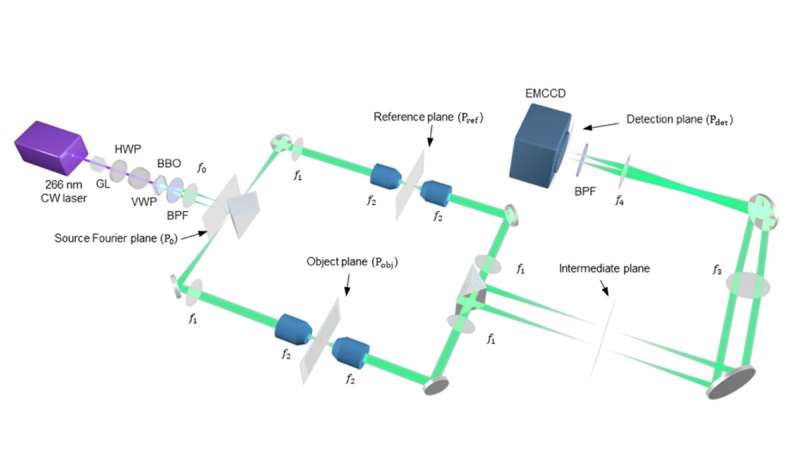
A diagram of the quantum microscopy by coincidence apparatus. Credit: Caltech
Quantum entanglement is not the only way to reduce the wavelength of light being used in a microscope. Green light has a shorter wavelength than red light, for example, and purple light has a shorter wavelength than green light. But due to another quirk of quantum physics, light with shorter wavelengths carries more energy. So, once you get down to light with a wavelength small enough to image tiny things, the light carries so much energy that it will damage the items being imaged, especially living things such as cells. This is why ultraviolet (UV) light, which has a very short wavelength, gives you a sunburn.

QMC gets around this limit by using biphotons that carry the lower energy of longer-wavelength photons while having the shorter wavelength of higher-energy photons.

"Cells don't like UV light," Wang says. "But if we can use 400-nanometer light to image the cell and achieve the effect of 200-nm light, which is UV, the cells will be happy, and we're getting the resolution of UV."

To achieve that, Wang's team built an optical apparatus that shines laser light into a special kind of crystal that converts some of the photons passing through it into biphotons. Even using this special crystal, the conversion is very rare and occurs in about one in a million photons. Using a series of mirrors, lenses, and prisms, each biphoton—which actually consists of two discrete photons—is split up and shuttled along two paths, so that one of the paired photons passes through the object being imaged and the other does not.

The photon passing through the object is called the signal photon, and the one that does not is called the idler photon. These photons then continue along through more optics until they reach a detector connected to a computer that builds an image of the cell based on the information carried by the signal photon. Amazingly, the paired photons remain entangled as a biphoton behaving at half the wavelength despite the presence of the object and their separate pathways.
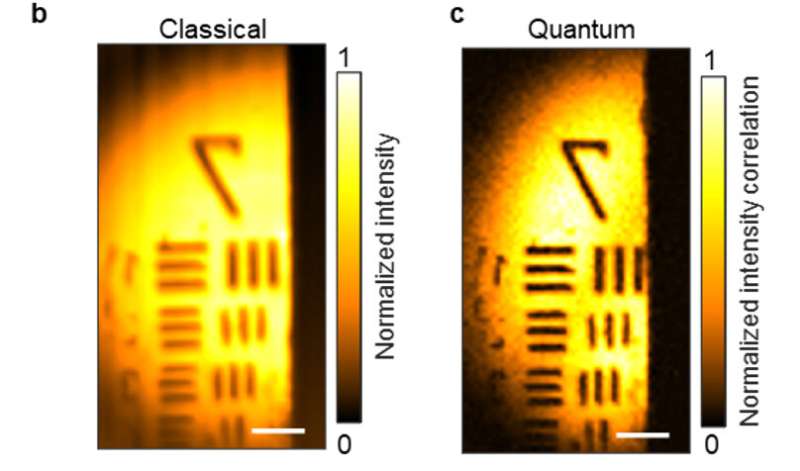
Images produced by standard microscopy and quantum microscopy. Credit: Caltech

Wang's lab was not the first to work on this kind of biphoton imaging, but it was the first to create a viable system using the concept. "We developed what we believe a rigorous theory as well as a faster and more accurate entanglement-measurement method. We reached microscopic resolution and imaged cells."

While there is no theoretical limit to the number of photons that can be entangled with each other, each additional photon would further increase the momentum of the resulting multiphoton while further decreasing its wavelength.

Wang says future research could enable entanglement of even more photons, although he notes that each extra photon further reduces the probability of a successful entanglement, which, as mentioned above, is already as low as a one-in-a-million chance.

The paper describing the work, "Quantum Microscopy of Cells at the Heisenberg Limit," appears in Nature Communications.

#quantumentanglement #quantumphysics #quantummechanics #entangledparticles #quantumteleportation #quantumcorrelation #quantuminformation #quantumcomputing


Visit:https://quantumtech.sfconferences.com/

Conference Submission: https://x-i.me/quncon
Award Nomination: https://x-i.me/quawards
conference&Registration:https://x-i.me/quareg1
Award Registration: https://x-i.me/quareg2
Member Nomination: https://x-i.me/quamember

Twitter :https://twitter.com/quantumtech23
Facebook:https://www.facebook.com/profile.php?id=100090774864954

Experimental quantum imaging distillation with undetected light

  It is possible to image an object with an induced coherence effect by making use of photon pairs to gain information on the item of intere...