Thursday, 11 May 2023

Bizarre Quantum Tunneling Observation Throws Out All the Rules


A chemical reaction is a bit like traveling from Vienna to Venice: your destination might be downhill, but to get there, you’ll need to cross the Alps. You can think of the energy changes molecules must go through as a landscape. Between the start and end of a reaction, this terrain can sometimes be so hilly that otherwise favorable reactions don’t happen at all if molecules lack the energy to make it over the bumps. Yet in some of these cases, such reactions do happen, thanks to quantum tunneling, which allows particles to occasionally bore through energy barriers they’d never be able to climb. This bizarre behavior is forbidden in traditional physics but allowed under the wild rules of quantum mechanics.

Now, in a new study published in Nature, scientists have managed to spot quantum tunneling in what classical physics would deem an impossible reaction between hydrogen molecules and deuterium ions—heavy, charged versions of hydrogen. This is the first time that researchers have managed to experimentally confirm a theoretical prediction about the rate of tunneling in a reaction involving ions. “Quantum mechanics in theory should be able to predict this [rate] very well,” says physicist Stephan Schlemmer of the University of Cologne in Germany, who was not involved in the study. “But nobody was sure whether this was really true.”

The idea that a particle could simply appear on the other side of an energy barrier traces back to German physicist Friedrich Hund. In 1927, while researching how molecules interact with light, he discovered that tunneling should be theoretically possible. According to quantum mechanics, particles are more like clouds of probability than solid spheres. These probability clouds, representing the location of a particle, extend out to infinity. So although it’s exceedingly unlikely, a quantum particle can theoretically pop up anywhere, including on the other side of an energy barrier that a classical particle could never cross.

In 1928 tunneling enjoyed perhaps the greatest of its first triumphs: tidily explaining nuclear alpha decay, a common type of radioactive decay in which atomic nuclei spit out “alpha particles”—helium nuclei with two protons and two neutrons—and transform into smaller nuclei in the process. At low temperatures, this reaction should be impossible, but it works with tunneling. Since then scientists have used tunneling to explain the otherwise unexplainable in contexts ranging from semiconductors to the hearts of stars.*

But even though the idea behind quantum tunneling is now nearly a century old, bringing theory and experiment together to observe tunneling in chemical reactions has proved tricky. First, quantum tunneling is rare enough that reactions dependent on it are usually glacially slow, making them tough to watch in the lab. And then there are the theoretical calculations themselves, which involve math so complicated that scientists can only predict tunneling reaction rates for the very simplest reactions. “With [reactions among] three atoms, you can do it,” says molecular physicist Roland Wester of the University of Innsbruck in Austria, who co-authored the new study. “With four atoms, there are a couple of groups who can handle it. And with five atoms, there’s basically nobody in the world who has the means to do it fully quantum.”

The reaction between hydrogen gas and deuterium ions is simple enough that it’s possible to predict the reaction rate with quantum mechanics alone. That is why Wester’s team chose to study this reaction: the researchers could actually check theory against reality. In the reaction, a molecule of hydrogen gas collides with one deuterium ion to produce a hydrogen ion and a heavy, deuterium-containing hydrogen molecule. But when theoretical physicist Viatcheslav Kokoouline of the University of Central Florida and his colleagues crunched the numbers in 2018, they predicted a reaction rate that was hundreds of times lower than the upper-limit estimate that was previously measured by Wester’s team.

“[The results] disagreed so much with the experiments, we didn’t want to publish,” Kokoouline says. Worried that they had made a mistake, he and his colleagues repeated their calculation using three different theoretical methods and got the same result. It was certainly possible that the calculations were wrong, but “we tried our best, and this is the number we [could] provide,” says Kokoouline’s former student Isaac Yuen, who is now a theoretical physicist at Kansas State University.

The problem was the reaction’s extremely slow rate, which took the Innsbruck team about 15 years of troubleshooting and tinkering to finally measure accurately. To do it, the researchers trapped deuterium ions in a cage of electric fields, flushed them with hydrogen gas and cooled everything down to an extremely chilly 15 kelvins. At temperatures that cold, the hydrogen and deuterium lacked the energy to react without tunneling. After waiting for about 15 minutes, the scientists measured how many hydrogen ions had been produced to find the reaction rate.

Fifteen minutes doesn’t sound like much, but for classical reactions, scientists often take measurements “for 100 milliseconds, and they see almost all ions converted to product,” Wester says. “We waited 1,000 seconds, and less than 1 percent of the ions converted into products.”

Tunneling occurred only about one in every 100 billion collisions between hydrogen and a deuterium ion, which agrees very well with Kokoouline and Yuen’s theoretical calculations. “It feels quite amazing that the numbers match with the experiments,” Yuen says. “I feel like it’s a big triumph, as a theorist.”

Tunneling reactions between ions such as this one are thought to be important for chemical synthesis in the diffuse, interstellar soup of ionized gas that provides the raw material for new star systems. Because the interstellar medium is so cold, classical reactions are very slow, but tunneling is more likely—particles move past each other more slowly at low temperatures, which ups the odds of tunneling.

Here on Earth, capturing this tiny tunneling rate for the first time shows that physicists are on the right track with their quantum molecular theories. And it provides a benchmark for testing future theoretical efforts to unite chemistry and quantum mechanics. “[In] our regular world of classical particles, reactions can be understood with some very simple concepts,” Schlemmer says. "But this tunneling is just a completely different world. And measurements like this open this world to us.”


#QuantumMystery #RuleBreaker #QuantumTunnelingRevolution #BeyondClassicalPhysics #QuantumMechanicsEnigma #BizarreObservation #NewFrontiersInScience #QuantumRevolution #UnchartedQuantumTerritory #ChallengingEstablishedTheories #QuantumWonders #BreakingBarriers #QuantumManipulation #FutureofQuantumTechnology #QuantumComputingAdvancements

Visit:https://quantumtech.sfconferences.com/ 

Conference Submission: https://x-i.me/quncon
 Award Nomination: https://x-i.me/quawards 
conference&Registration:https://x-i.me/quareg1 
Award Registration: https://x-i.me/quareg2 
Member Nomination: https://x-i.me/quamember 
Twitter:https://twitter.com/quantumtech23
 Instagram:https://www.instagram.com/sahara_navi/ 
Facebook:https://www.facebook.com/profile.php?id=100090774864954


Friday, 5 May 2023

“Spooky” Quantum Entanglement of Photons Doubles Microscope Resolution


Researchers at Caltech have utilized quantum entanglement to double the resolution of light microscopes. The new technique, called quantum microscopy by coincidence, involves the entanglement of photons, which act as biphotons with double the momentum of a single photon. This results in a shorter wavelength, allowing the microscope to achieve greater resolution without damaging the specimens being observed, such as living cells. The team built an optical apparatus that used a special crystal to convert photons into biphotons and demonstrated microscopic resolution and cell imaging with their innovative system.

Using a “spooky” phenomenon of quantum physics, Caltech researchers have discovered a way to double the resolution of light microscopes.

In a paper published on April 28 in the journal Nature Communications, a team led by Lihong Wang, Bren Professor of Medical Engineering and Electrical Engineering, shows the achievement of a leap forward in microscopy through what is known as quantum entanglement. Quantum entanglement is a phenomenon in which two particles are linked such that the state of one particle is tied to the state of the other particle regardless of whether the particles are anywhere near each other. Albert Einstein famously referred to quantum entanglement as “spooky action at a distance” because it could not be explained by his relativity theory.

According to quantum theory, any type of particle can be entangled. In the case of Wang’s new microscopy technique, dubbed quantum microscopy by coincidence (QMC), the entangled particles are photons. Collectively, two entangled photons are known as a biphoton, and, importantly for Wang’s microscopy, they behave in some ways as a single particle that has double the momentum of a single photon.

Since quantum mechanics says that all particles are also waves, and that the wavelength of a wave is inversely related to the momentum of the particle, particles with larger momenta have smaller wavelengths. So, because a biphoton has double the momentum of a photon, its wavelength is half that of the individual photons.

This is key to how QMC works. A microscope can only image the features of an object whose minimum size is half the wavelength of light used by the microscope. Reducing the wavelength of that light means the microscope can see even smaller things, which results in increased resolution.

Quantum entanglement is not the only way to reduce the wavelength of light being used in a microscope. Green light has a shorter wavelength than red light, for example, and purple light has a shorter wavelength than green light. But due to another quirk of quantum physics, light with shorter wavelengths carries more energy. So, once you get down to light with a wavelength small enough to image tiny things, the light carries so much energy that it will damage the items being imaged, especially living things such as cells. This is why ultraviolet (UV) light, which has a very short wavelength, gives you a sunburn.

QMC gets around this limit by using biphotons that carry the lower energy of longer-wavelength photons while having the shorter wavelength of higher-energy photons.

“Cells don’t like UV light,” Wang says. “But if we can use 400-nanometer light to image the cell and achieve the effect of 200-nm light, which is UV, the cells will be happy, and we’re getting the resolution of UV.”

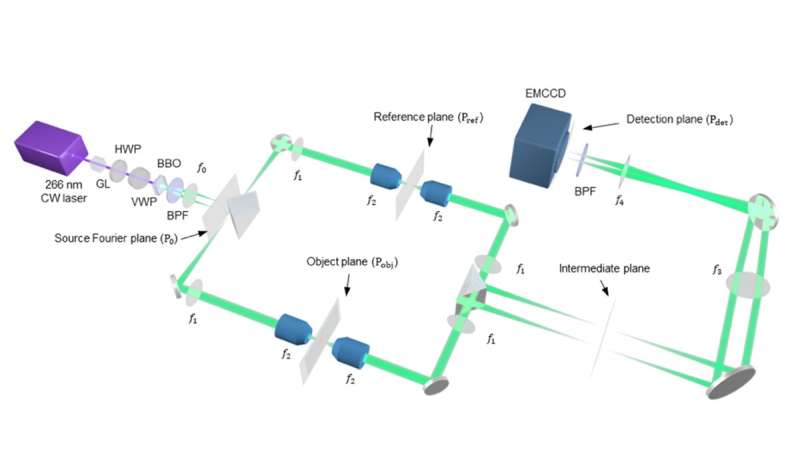
To achieve that, Wang’s team built an optical apparatus that shines laser light into a special kind of crystal that converts some of the photons passing through it into biphotons. Even using this special crystal, the conversion is very rare and occurs in about one in a million photons. Using a series of mirrors, lenses, and prisms, each biphoton—which actually consists of two discrete photons—is split up and shuttled along two paths, so that one of the paired photons passes through the object being imaged and the other does not. The photon passing through the object is called the signal photon, and the one that does not is called the idler photon. These photons then continue along through more optics until they reach a detector connected to a computer that builds an image of the cell based on the information carried by the signal photon. Amazingly, the paired photons remain entangled as a biphoton behaving at half the wavelength despite the presence of the object and their separate pathways.


#QuantumComputing #FaultTolerant #Physicists #ErrorCorrection #QuantumErrors #QuantumInformation #Decoherence #QuantumApplications #QuantumComputation #Qubits#Reliability #ExperimentalDemonstration #QuantumTechnologies #PracticalQuantumComputers #QuantumErrorCorrection

Website :https://quantumtech.sfconferences.com/
Award Nomination: https://x-i.me/quawards
Award Registration: https://x-i.me/quareg2
Twitter :https://twitter.com/quantumtech23

Wednesday, 3 May 2023

Quantum entanglement of photons doubles microscope resolution


Using a "spooky" phenomenon of quantum physics, Caltech researchers have discovered a way to double the resolution of light microscopes.

In a paper appearing in the journal Nature Communications, a team led by Lihong Wang, Bren Professor of Medical Engineering and Electrical Engineering, shows the achievement of a leap forward in microscopy through what is known as quantum entanglement. Quantum entanglement is a phenomenon in which two particles are linked such that the state of one particle is tied to the state of the other particle regardless of whether the particles are anywhere near each other. Albert Einstein famously referred to quantum entanglement as "spooky action at a distance" because it could not be explained by his relativity theory.

According to quantum theory, any type of particle can be entangled. In the case of Wang's new microscopy technique, dubbed quantum microscopy by coincidence (QMC), the entangled particles are photons. Collectively, two entangled photons are known as a biphoton, and, importantly for Wang's microscopy, they behave in some ways as a single particle that has double the momentum of a single photon.

Since quantum mechanics says that all particles are also waves, and that the wavelength of a wave is inversely related to the momentum of the particle, particles with larger momenta have smaller wavelengths. So, because a biphoton has double the momentum of a photon, its wavelength is half that of the individual photons.

This is key to how QMC works. A microscope can only image the features of an object whose minimum size is half the wavelength of light used by the microscope. Reducing the wavelength of that light means the microscope can see even smaller things, which results in increased resolution.
A diagram of the quantum microscopy by coincidence apparatus. Credit: Caltech

Quantum entanglement is not the only way to reduce the wavelength of light being used in a microscope. Green light has a shorter wavelength than red light, for example, and purple light has a shorter wavelength than green light. But due to another quirk of quantum physics, light with shorter wavelengths carries more energy. So, once you get down to light with a wavelength small enough to image tiny things, the light carries so much energy that it will damage the items being imaged, especially living things such as cells. This is why ultraviolet (UV) light, which has a very short wavelength, gives you a sunburn.

QMC gets around this limit by using biphotons that carry the lower energy of longer-wavelength photons while having the shorter wavelength of higher-energy photons.

"Cells don't like UV light," Wang says. "But if we can use 400-nanometer light to image the cell and achieve the effect of 200-nm light, which is UV, the cells will be happy, and we're getting the resolution of UV."

To achieve that, Wang's team built an optical apparatus that shines laser light into a special kind of crystal that converts some of the photons passing through it into biphotons. Even using this special crystal, the conversion is very rare and occurs in about one in a million photons. Using a series of mirrors, lenses, and prisms, each biphoton—which actually consists of two discrete photons—is split up and shuttled along two paths, so that one of the paired photons passes through the object being imaged and the other does not.

The photon passing through the object is called the signal photon, and the one that does not is called the idler photon. These photons then continue along through more optics until they reach a detector connected to a computer that builds an image of the cell based on the information carried by the signal photon. Amazingly, the paired photons remain entangled as a biphoton behaving at half the wavelength despite the presence of the object and their separate pathways.
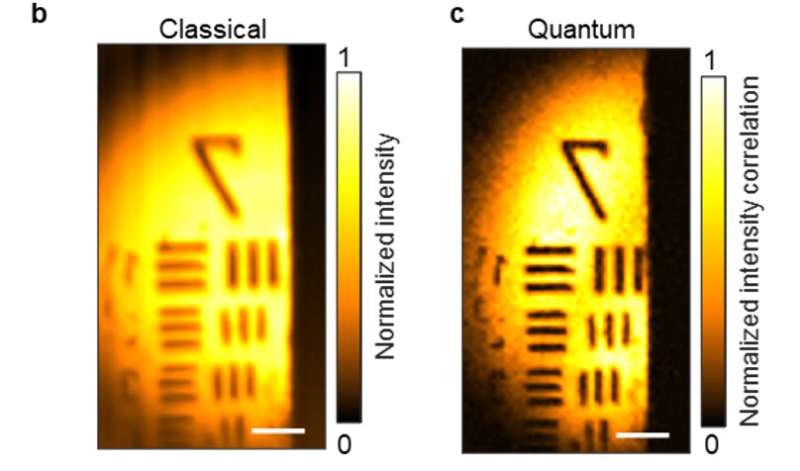
Images produced by standard microscopy and quantum microscopy. Credit: Caltech

Wang's lab was not the first to work on this kind of biphoton imaging, but it was the first to create a viable system using the concept. "We developed what we believe a rigorous theory as well as a faster and more accurate entanglement-measurement method. We reached microscopic resolution and imaged cells."

While there is no theoretical limit to the number of photons that can be entangled with each other, each additional photon would further increase the momentum of the resulting multiphoton while further decreasing its wavelength.

Wang says future research could enable entanglement of even more photons, although he notes that each extra photon further reduces the probability of a successful entanglement, which, as mentioned above, is already as low as a one-in-a-million chance.

The paper describing the work, "Quantum Microscopy of Cells at the Heisenberg Limit," appears in Nature Communications.

#quantumentanglement #quantumphysics #quantummechanics #entangledparticles #quantumteleportation #quantumcorrelation #quantuminformation #quantumcomputing


Visit:https://quantumtech.sfconferences.com/

Conference Submission: https://x-i.me/quncon
Award Nomination: https://x-i.me/quawards
conference&Registration:https://x-i.me/quareg1
Award Registration: https://x-i.me/quareg2
Member Nomination: https://x-i.me/quamember

Twitter :https://twitter.com/quantumtech23
Facebook:https://www.facebook.com/profile.php?id=100090774864954

Tuesday, 25 April 2023

Quantum 'magic' could help explain the origin of spacetime


A quantum property dubbed "magic" could be the key to explaining how space and time emerged, a new mathematical analysis by three RIKEN physicists suggests. The research is published in the journal Physical Review D.

It's hard to conceive of anything more basic than the fabric of spacetime that underpins the universe, but theoretical physicists have been questioning this assumption. "Physicists have long been fascinated about the possibility that space and time are not fundamental, but rather are derived from something deeper," says Kanato Goto of the RIKEN Interdisciplinary Theoretical and Mathematical Sciences (iTHEMS).
This notion received a boost in the 1990s, when theoretical physicist Juan Maldacena related the gravitational theory that governs spacetime to a theory involving quantum particles. In particular, he imagined a hypothetical space—which can be pictured as being enclosed in something like an infinite soup can, or "bulk"—holding objects like black holes that are acted on by gravity. Maldacena also imagined particles moving on the surface of the can, controlled by quantum mechanics. He realized that mathematically a quantum theory used to describe the particles on the boundary is equivalent to a gravitational theory describing the black holes and spacetime inside the bulk.

"This relationship indicates that spacetime itself does not exist fundamentally, but emerges from some quantum nature," says Goto. "Physicists are trying to understand the quantum property that is key."

The original thought was that quantum entanglement—which links particles no matter how far they are separated—was the most important factor: the more entangled particles on the boundary are, the smoother the spacetime within the bulk.

"But just considering the degree of entanglement on the boundary cannot explain all the properties of black holes, for instance, how their interiors can grow," says Goto.

So Goto and iTHEMS colleagues Tomoki Nosaka and Masahiro Nozaki searched for another quantum quantity that could apply to the boundary system and could also be mapped to the bulk to describe black holes more fully. In particular, they noted that black holes have a chaotic characteristic that needs to be described.

"When you throw something into a black hole, information about it gets scrambled and cannot be recovered," says Goto. "This scrambling is a manifestation of chaos."

The team came across "magic," which is a mathematical measure of how difficult a quantum state is to simulate using an ordinary classical (non-quantum) computer. Their calculations showed that in a chaotic system almost any state will evolve into one that is "maximally magical"—the most difficult to simulate.

This provides the first direct link between the quantum property of magic and the chaotic nature of black holes. "This finding suggests that magic is strongly involved in the emergence of spacetime," says Goto.

#quantumphysics #spacetime #cosmology #theoreticalphysics #quantumgravity


Visit:https://quantumtech.sfconferences.com/

Award Nomination: https://x-i.me/quawards

Award Registration: https://x-i.me/quareg2


Thursday, 13 April 2023

Physicists take step toward fault-tolerant quantum computing


Some classical computers have error correction built into their memories based on bits; quantum computers, to be workable in the future, will need error correction mechanisms, too, based on the vastly more sensitive qubits.


Cornell researchers have recently taken a step toward fault-tolerant quantum computing: they constructed a simple model containing exotic particles called non-Abelian anyons, compact and practical enough to run on modern quantum hardware. Realizing these particles, which can only exist in two dimensions, is a move towards implementing it in the real world.


Thanks to some creative thinking, Yuri Lensky, a former Bethe/Wilkins/Kavli Institute at Cornell (KIC) postdoctoral fellow in physics in the College of Arts and Sciences (A&S), collaborating with Eun-Ah Kim, professor of physics (A&S), came up with a simple "recipe" that could be used for robustly computing with non-Abelian anyons, including specific instructions for executing the effect experimentally on devices available today.

Their paper, "Graph Gauge Theory of Mobile Non-Abelian Anyons in a Qubit Stabilizer Code," written in collaboration with theorists at Google Quantum AI, published March 24 in Annals of Physics. Google Quantum AI researchers, together with Lensky and Kim, have proved the theory with a successful experiment as reported in a preprint publication, "Observation of Non-Abelian Exchange Statistics on a Superconducting Processor," on the research-sharing platform arXiv.

"This two-dimensional state is interesting both from a quantum condensed matter physics perspective—it has some novel properties that are very special to 2D physics—and from a quantum information perspective," Lensky said. "It's something truly quantum, but it's also potentially useful for quantum computation. It protects bits of quantum information by storing them non-locally, and our protocol allows us to compute with these bits."

Kim explained the principle that animates non-Abelian anyons by holding out two identical one-pound barbells. When she crosses her arms, the identical barbells change positions, but as objects defined by classical physics, their state remains the same. They are interchangeable.

If those barbells represent two identical quantum particles, remarkably in certain 2D systems their trails through space-time can produce a measurable record of the change (picture the crossed arms.) This process of exchange is called a braid, after the shapes of the particle trails.

"Quantum mechanically, when you move one particle around the other," Kim said, holding one weight still and moving the other in a circle around it, "the wave function, which is a solution to the Schrödinger equation describing quantum mechanical motion, can be multiplied by a phase factor or it can become something that's very different."

When the wave function gains a global sign that can only be observed through interferometry, a measurement of the interference of waves, that's called an Abelian anyon. When the wave function becomes measurably different, it's a non-Abelian anyon, she said.

Non-Abelian anyons could be harnessed to create qubits defined not on a single particle, but on a pair of identical quantum particles: nonlocally encoded.

"If I put the qubit shared between these particles in a zero state and move them apart, then whatever happens locally to one of these anyons, the zero state will remain. The qubit set to zero is safe from corruption," Kim said. "Non-Abelian anyons could be used in a platform for protected qubits."

But while physicists have theorized about these exotic particles for years—Alexei Kitaev proposed operating on protected bits of quantum memory by braiding non-Abelian anyons back around 2001, Lensky said—they have never been observed in a physical system before now.

When Google Quantum AI developed the quantum processor platform capabilities to realize the surface code and braiding of Abelian anyons in a physical system, Lensky said, "This was [our] inspiration to look for a way to realize the physics of non-Abelian anyons as soon as possible."

"We knew they had the working ingredients, but they didn't have a recipe," Kim said. "We figured out how to move these non-Abelian anyons, then we told the experimentalists what to do. It was possible because Yuri and I were thinking in a flexible, creative and open-minded way."

Past theoretical research identified non-Abelian properties, but came up short on how to move them, a necessary step. A key insight from Lensky and Kim was to give up the regularity of a grid and arrange qubits in an almost hand-drawn manner but backed up by robust mathematics.

"After this simple geometric insight, using gauge theory, we were able to come up with the protocol of taking this picture and implementing it on a chip in a robust and efficient way," Kim said. "With this 10-qubit system, we were able to encode multiple non-Abelian anyons, and therefore multiple logical information-carrying qubits, and a precise recipe for what the experimentalists need to do every step of the way."

"Although the focus of the theory and experiment is simply to realize non-Abelian anyons in the real world, this can also be viewed as a first small step towards implementing computation by braiding," Lensky said

#QuantumComputing #FaultTolerant #Physicists #ErrorCorrection #QuantumErrors #QuantumInformation #Decoherence #QuantumApplications #QuantumComputation #Qubits#Reliability #ExperimentalDemonstration #QuantumTechnologies #PracticalQuantumComputers #QuantumErrorCorrection
 
Website :https://quantumtech.sfconferences.com/
Award Nomination: https://x-i.me/quawards
Award Registration: https://x-i.me/quareg2
Twitter :https://twitter.com/quantumtech23

Saturday, 8 April 2023

Researchers make an important step towards the quantum internet using diamond nanostructures


Diamond material is of great importance for future technologies such as the quantum internet. Special defect centers can be used as quantum bits (qubits) and emit single light particles that are referred to as single photons.

To enable data transmission with feasible communication rates over long distances in a quantum network, all photons must be collected in optical fibers and transmitted without being lost. It must also be ensured that these photons all have the same color, i.e., the same frequency. Fulfilling these requirements has been impossible until now.

Researchers in the "Integrated Quantum Photonics" group led by Prof. Dr. Tim Schröder at Humboldt-Universität zu Berlin have succeeded for the first time worldwide in generating and detecting photons with stable photon frequencies emitted from quantum light sources, or, more precisely, from nitrogen-vacancy defect centers in diamond nanostructures.

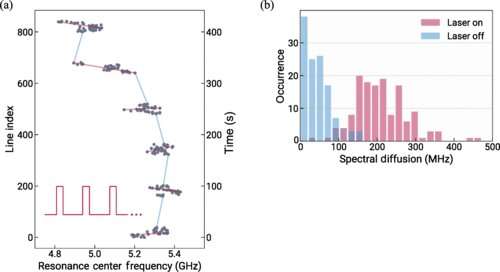
This was enabled by carefully choosing the diamond material; sophisticated nanofabrication methods carried out at the Joint Lab Diamond Nanophotonics of the Ferdinand-Braun-Institut, Leibniz-Institut für Höchstfrequenztechnik; and specific experimental control protocols. By combining these methods, the noise of the electrons, which previously disturbed data transmission, can be significantly reduced, and the photons are emitted at a stable (communication) frequency.


In addition, the Berlin researchers show that the current communication rates between spatially separated quantum systems can prospectively be increased more than 1,000-fold with the help of the developed methods—an important step closer to a future quantum internet.

The scientists have integrated individual qubits into optimized diamond nanostructures. These structures are 1,000 times thinner than a human hair and make it possible to transfer emitted photons in a directed manner into glass fibers.

However, during the fabrication of the nanostructures, the material surface is damaged at the atomic level, and free electrons create uncontrollable noise for the generated light particles. Noise, comparable to an unstable radio frequency, causes fluctuations in the photon frequency, preventing successful quantum operations such as entanglement.

A special feature of the diamond material used is its relatively high density of nitrogen impurity atoms in the crystal lattice. These possibly shield the quantum light source from electron noise at the surface of the nanostructure. "However, the exact physical processes need to be studied in more detail in the future," explains Laura Orphal-Kobin, who investigates quantum systems together with Prof. Dr. Tim Schröder.

The conclusions drawn from the experimental observations are supported by statistical models and simulations, which Dr. Gregor Pieplow from the same research group is developing and implementing together with the experimental physicists.


#quantuminternet #diamondnanostructures #quantumcomputing #quantumcommunication

Visit:https://quantumtech.sfconferences.com/

Twitter :https://twitter.com/quantumtech23

Pinterest:https://in.pinterest.com/quantumtechnology23/

Monday, 3 April 2023

Seeing is more than believing: Exploring 'de Sitter space' to explain gravity in the expanding early universe


Having more tools helps; having the right tools is better. Utilizing multiple dimensions may simplify difficult problems—not only in science fiction but also in physics—and tie together conflicting theories.


For example, Einstein's theory of general relativity—which resides in the fabric of space-time warped by planetary or other massive objects—explains how gravity works in most cases. However, the theory breaks down under extreme conditions such as those existing in black holes and cosmic primordial soups.

An approach known as superstring theory could use another dimension to help bridge Einstein's theory with quantum mechanics, solving many of these problems. But the necessary evidence to support this proposal has been lacking.

Now, a team of researchers led by Kyoto University is exploring 'de Sitter space' to invoke a higher dimension to explain gravity in the expanding early universe. They have developed a concrete method to compute correlation functions among fluctuations on expanding universe by making use of holography.

"We came to realize that our method can be applied more generically than we expected while dealing with quantum gravity," says Yasuaki Hikida, from the Yukawa Institute for Theoretical Physics.

Dutch astronomer Willem de Sitter's theoretical models describe space in a way that fits with Einstein's general theory of relativity, in that the positive cosmological constant accounts for the expansion of the universe.

Starting with existing methods for handling gravity in anti-de Sitter space, Hikida's team reshaped them to work in expanding de Sitter space to more precisely account for what is already known about the universe.

"We are now extending our analysis to investigate cosmological entropy and quantum gravity effects," adds Hikida.

Although the team's calculations only considered a three-dimensional universe as a test case, the analysis may easily be extended to a four-dimensional universe, allowing for the extraction of information from our real world.

"Our approach possibly contributes to validating superstring theory and allows for practical calculations about the subtle changes that rippled across the fabric of our early universe."

The study is published in the journal Physical Review Letters.


#quantum #quantumphysics #quantumcomputing #quantumoptics #quantumlight

Visit:https://quantumtech.sfconferences.com/

Twitter :https://twitter.com/quantumtech23

Instagram :https://www.instagram.com/sahara_navi/

Experimental quantum imaging distillation with undetected light

  It is possible to image an object with an induced coherence effect by making use of photon pairs to gain information on the item of intere...